
Difference Between Snooker and Pool: A Guide
When it comes to cue sports, few games are as popular or skillful as snooker and pool. Both are played on green baize tables with balls and cues, yet they differ significantly in rules, equipment, strategy, and scoring. Whether you’re a beginner looking to understand the basics or an enthusiast hoping to deepen your knowledge, this guide from 24/7 pool will walk you through the core differences between snooker and pool.
For further insights and online games, make sure to check out the rest of this site as your ultimate resource for everything pool-related.
1. Understanding Snooker vs. Pool
At first glance, snooker and pool may look similar, both of them involve striking balls on a felt covered table with a cue. However, these games evolved in different contexts and have distinct traditions and rule sets.
Snooker originated in the late 19th century among British Army officers stationed in India. The game’s rules and table dimensions were designed to test precision and endurance. Snooker is traditionally played on a larger table, uses more balls, and emphasizes long-term strategic positioning.
Pool, especially in its most common form (eight-ball and nine-ball), developed in America and quickly became a favorite in bars, pool halls, and competitive leagues. Pool tables are smaller, the games are often faster paced, and the rules vary by style. While snooker challenges sustained accuracy and planning, pool places a premium on quick thinking, pattern play, and aggressive shot-making.
2. Key Equipment Differences
A major distinction between snooker and pool lies in the equipment used, particularly table size, balls and cues.
Table Size
Snooker Tables: The standard snooker table measures 12 feet by 6 feet, a large playing surface that demands precise control and power management. The bigger table spreads balls further apart and increases the difficulty of positional play.
Pool Tables: Pool tables are smaller and come in several sizes, but the most common recreational size is 7 or 8 feet long. Competitive pool frequently uses 9-foot tables, but even these are smaller than snooker tables.
Balls
Snooker Balls: Snooker uses 21 object balls, 15 reds and 6 colored balls (yellow, green, brown, blue, pink, and black), plus a white cue ball. Each ball has a specific point value, and the game’s rhythm revolves around alternating potting reds and colors.
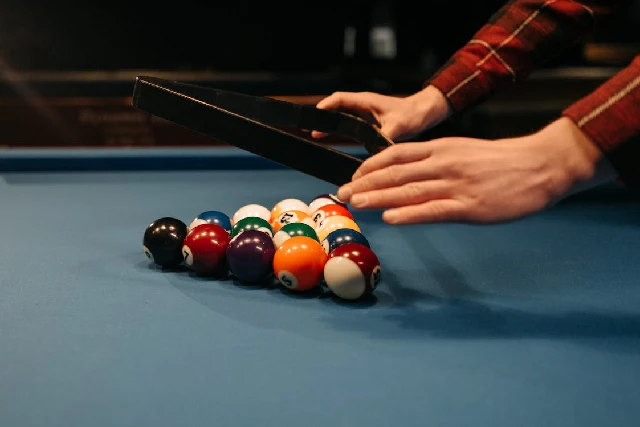
Pool Balls: Pool typically uses 16 balls, one cue ball and 15 object balls. In eight-ball, balls are divided into solids (1–7) and stripes (9–15), with the 8-ball as the game’s final target. In nine-ball, only balls 1 through 9 are used.
Cues
While both games use similar cue sticks, subtle differences exist. Snooker cues are usually lighter and have smaller tips designed for the smaller snooker balls and the fine precision snooker demands. Pool cues can be slightly heavier with larger tips, reflecting the larger pool balls and the emphasis on powerful breaks and spin.
3. Scoring Systems Explained
Scoring in snooker and pool couldn’t be more different, the systems reflect the games’ unique objectives and pacing.
Snooker Scoring
In snooker, each ball has a point value:
- Red: 1 point
- Yellow: 2 points
- Green: 3 points
- Brown: 4 points
- Blue: 5 points
- Pink: 6 points
- Black: 7 points
The standard scoring sequence involves potting a red, followed by a color, then another red, and so on, until all of the reds are cleared. After the reds are gone, the colors must be pocketed in ascending order.
The total number of points available in a frame is high, and scores often exceed 50 points for a single player’s break.
Pool Scoring
Pool scoring varies significantly by game type:
- Eight-Ball: Pocket all of your assigned group (solids or stripes) and then legally pot the 8-ball to win. There’s no point tally; the win condition is purely about completing the sequence of balls.
- Nine-Ball: Hit the lowest-numbered ball first; combinations and caroms are allowed. The player who legally pots the 9-ball wins.
There is no cumulative point scoring in most pool games. Matches are typically decided by winning individual games or racks rather than accumulating points over time.
4. Strategy Differences
The strategic demands of snooker and pool reflect their equipment and scoring systems.
Snooker Strategy
Snooker rewards patience, precision, and long-term planning. Because the table is large and the balls are tightly clustered at the start, players must think several shots ahead. Position play is critical; leaving yourself well-positioned for the next shot is as important as making the current one. Safety play means deliberately leaving your opponent in a difficult position, which is a central tactic in this game.
Pool Strategy
Pool strategy is generally more aggressive and varied. In eight-ball, players balance offense and defense while planning efficient shot patterns. Choosing the best sequence of shots is key to running the table while avoiding giving easy opportunities to opponents. In nine-ball, momentum and positioning are crucial, with players aiming to maintain control of the table. Break shots are especially important, and a strong break can set the tone for the entire game.
Final Thoughts
While snooker and pool share a common heritage as cue sports, they differ significantly in equipment, rules, scoring, and tactical emphasis. Snooker is a game of endurance, precision, and finesse on a large table with complex scoring, while pool offers faster-paced play with varied rule sets and strategic styles. Whether you’re aiming to improve your game or simply understand the nuances between these two classics, appreciating their differences enriches your cue sport experience.
Seasonal Pool Games


More Games




Pool News
Disclaimer
DISCLAIMER: The games on this website are using PLAY (fake) money. No payouts will be awarded, there are no "winnings", as all games represented by 247 Games LLC are free to play. Play strictly for fun.